What to Look For in a Pilates Teacher Training Program
Aug 11, 2026
If you are researching Pilates teacher trainings right now, you have probably noticed the programs don't match.
One is a weekend. Another takes two years. The prices are all over the map, and so is what you actually get for the money.
Here is the honest problem. You can read every website twice and still not know which program is the real one.
So I am not going to try to convince you that ALIGN is right for you. I am going to tell you what to look for in any program, including mine. I don't want you wasting your time or your money.
Choosing where to train is one of the biggest decisions you will make as a teacher. If it feels daunting, that is the right response. It is a big deal. Before you put any money down, here are the questions worth asking.
Start with the curriculum
Every certification is built on a curriculum. Before you enroll anywhere, find out what a program teaches, and where that curriculum came from.
ALIGN Pilates Teacher Training is built on the Balanced Body® curriculum. It is one of the most widely recognized standards in Pilates, trusted by studios and teachers around the world. That matters for one plain reason. The credential you earn is recognized far past the studio where you trained.
The Balanced Body® work is rooted in the classical Pilates repertoire. You learn the exercises, why each one exists in the body, and how to build from a first-timer up to advanced movement. That grounding is what lets you teach with intention instead of running people through a list of moves.
When you look at any program, ask:
- What is the curriculum based on?
- Who created it?
- Is the credential recognized outside the studio that runs the training?
The three certification paths
There is no single Pilates certification. The right path depends on what you want to teach, and how wide you want to be able to work.
Through ALIGN and Balanced Body®, there are three.
Mat covers the mat repertoire. It is the most accessible way in, and you don't need equipment to complete it.
Reformer covers the reformer, the piece you see most in boutique studios. This is where most studio jobs are.
Comprehensive covers the full apparatus: Reformer, Chair, Cadillac, Tower, and Barrel. It is the most complete path, and it opens the most doors for a long career teaching Pilates.
You can also do Mat and Reformer together. The program is modular and self-paced, so you move through it at a speed that fits your life.
What the hours actually involve
Every program requires a set number of hours. What those hours look like in real life is the part programs don't always spell out.
There are usually three kinds.
Observation hours: you watch classes being taught. Practice teaching hours: you teach real people and build hands-on experience. Personal practice hours: you keep working on your own movement.
How you complete them is where programs differ a lot. On your own, you are the one lining up classes to observe, finding bodies to practice on, and logging every hour yourself. Inside a structured program like the ALIGN Mentor Program, the space and the schedule to get those hours done are built around you, so you are not chasing them alone after the weekend ends.
Before you enroll anywhere, ask:
- How do students complete their observation and practice teaching hours?
- What is in place to help you do it?
Be clear on the time commitment
ALIGN's modular format is built to fit around a full life. Most modules run Friday through Sunday, six hours a day. You do not have to quit your job to start!
There is also an online option if you can't attend in person. Same curriculum as the in-person modules, taught remotely. That opens the program to people outside Austin and Houston.
How long the whole thing takes depends on you. How fast you move through the modules, and how steadily you work on your hours. Some people finish in six months. Others take longer, and that is fine. It is self-paced, so the timeline is mostly in your hands.
One question worth asking any program:
- What does completion realistically take for most students? (Not the fastest possible time. The real one.)
Understand the full cost before you start
This is the one I would not skip. You should be able to see the whole number before you decide anything. If a program can only tell you the price of the first piece, that is worth noticing.
Here is what certification through ALIGN costs.
| Path | Estimated Cost | Format |
|---|---|---|
| Mat Certification | $2,500 to $3,000 | In person or online |
| Reformer Certification | 4,400 to $4,800 | In person or online |
| Comprehensive Certification | $5,675 to $6,250 | In person or online |
Additional costs and details
| Item | Details |
|---|---|
| Test-out fee | $300, scheduled with an ALIGN Master Educator |
| Practice and observation | $0 with the ALIGN Mentor Program. Per-class fee if completed elsewhere |
| Optional Mentor Program | $66 to $150 per month |
Early-bird pricing is available when you register for a module at least 30 days ahead. Over a full certification, that adds up.
Getting certified is where it starts
A good program does more than hand you a certificate. It gets you ready to walk into a studio and teach a real class, safely and with actual confidence.
The Balanced Body® credential is recognized widely, so studios know what it means when they see it on your resume. That reputation helps when you are new and looking for your first classes.
But the credential is only half of it. How you feel walking into that first class comes down to how well you were prepared. How many hours you taught. How much honest feedback you got. Whether anyone taught you to read the room in front of you, not just run the exercises.
That last part is the whole job. A good teacher sees the person on the reformer, knows what to say, and knows when to say nothing at all. The goal is not to memorize cues. It is to become the instructor people book again, because six minutes into class something in their body felt different.
Ask any program you are considering:
- What do graduates usually do after they certify?
- What does the program do to get you ready for that?
One thing worth saying plainly
Real Pilates certification takes time. When a program promises full certification in a weekend, or in some very short window, it is offering something real in terms of exercise knowledge. But the hours it takes to build genuine teaching confidence can't be rushed.
There is no Pilates police. Not every program is held to the same standard. Some are run by a big studio chain that will take a fitness instructor, put them through a four-hour course, and call them certified. That is legal. It is also not the same thing as being trained to teach.
Learning the exercises is one part. Learning to read different bodies, cue them, build a class that goes somewhere, and find your own voice, that comes from repetition and feedback over time. A serious program builds the structure for it. A compressed one usually can't.
None of this means short programs are worthless. But if your goal is to teach in a studio and feel ready, the time you put into a thorough program shows up later, in how steady you feel on the floor.
Where to start
If this made the decision feel like a lot, that is normal. Most people I talk to are not sure where to begin, even after they have read everything. That is not an information problem. It is a big leap, and it is hard to sort out alone.
I waited a year to work up the nerve to take my first module. So when I say the hardest part is starting, I mean it.
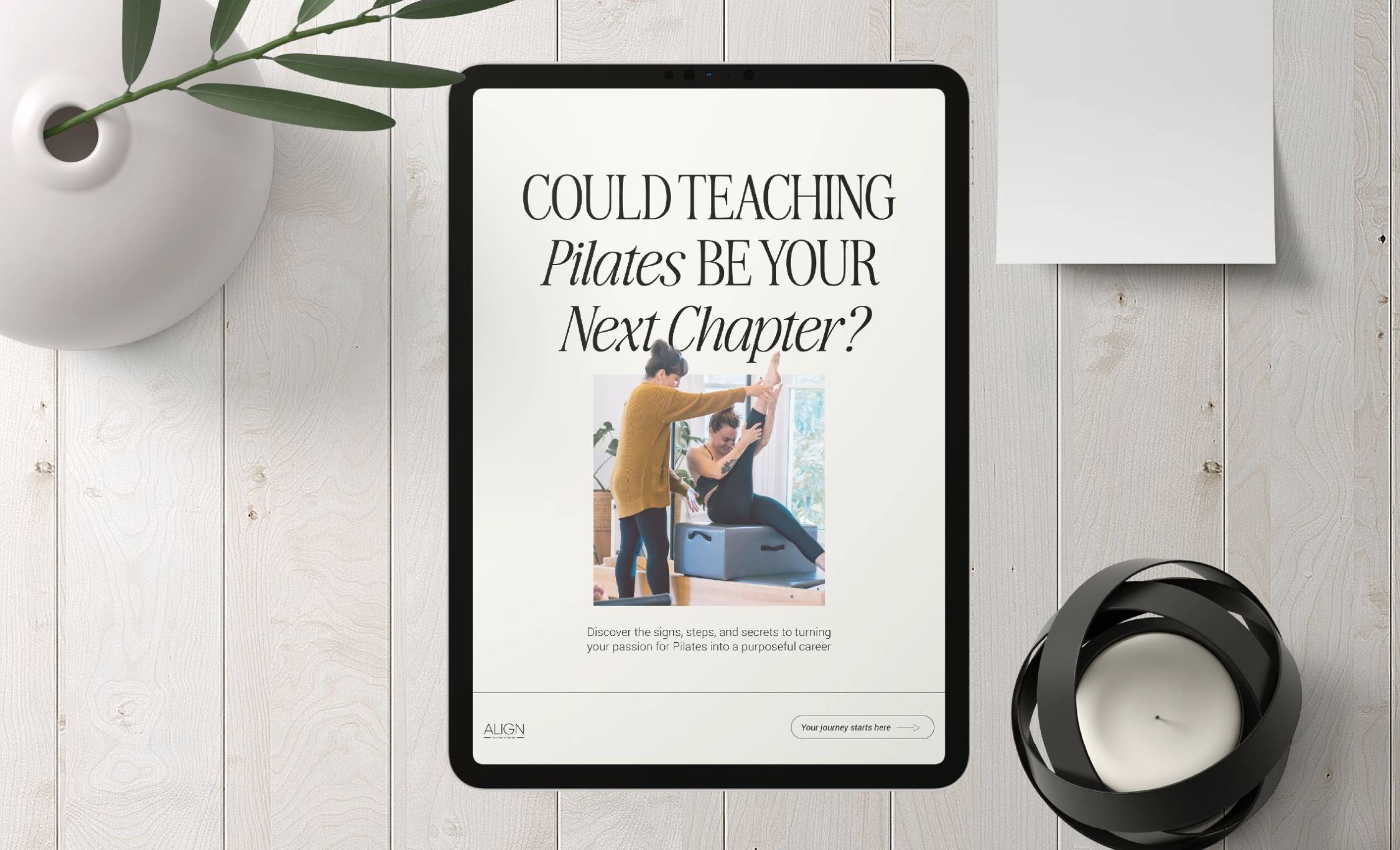
So let me make the next step simple. I put together a free guide that lays out the paths, the costs, and what the journey actually looks like from where you are. It is everything above, in one place you can keep and come back to.
And when you want to ask a real person your own questions, I run a free webinar. No pitch. I am there to be a resource, so you can find the right next step, even if it turns out not to be ALIGN.
Prefer to just watch? Come to the free training with me.
Not sure what your next step is?
Bring your questions about Pilates teacher training and becoming a Pilates instructor. We’ll talk through what to look for in a training program, including Balanced Body® education, so you can feel more confident choosing the right next step.
No pitch, just a real conversation and a chance to get the information you need.